
The Greatest Formula 1 Races of All Time — What Made Them Unforgettable
The Greatest Formula 1 Races of All Time — What Made Them Unforgettable
Formula 1 has produced thousands of races, but only a select few continue to live in the sport’s collective memory. The greatest are not always the closest, the fastest or the most important to a championship. Some are remembered for an extraordinary drive, others for a decisive strategic gamble, a sudden change in weather or a finish that altered the course of F1 history.
This ranking weighs several qualities together: the quality of the on-track contest, the scale of the human performance, strategic and weather drama, championship consequence, historical importance and lasting cultural memory. It is necessarily debatable. A thrilling race is not always a historically important one, and a culturally iconic Grand Prix may be remembered as much for what it represented as for every lap of the contest. With that distinction in mind, these are eight races that remain unforgettable.
8. 1998 Belgian Grand Prix — Spa-Francorchamps
The 1998 Belgian Grand Prix had almost everything a chaotic Spa race could offer: heavy rain, poor visibility, a huge first-lap accident and a championship battle that repeatedly threatened to boil over. David Coulthard’s McLaren spun in the spray and was collected by several cars, producing one of the most dramatic opening incidents in modern F1.
Michael Schumacher appeared to have control of the race for Ferrari until he caught Coulthard’s damaged McLaren and collided with it while attempting to pass. With both leading Ferraris out, Damon Hill inherited the lead and guided Jordan to its first Formula 1 victory. Ralf Schumacher finished second, completing a remarkable team result. Spa’s fast, exposed layout made the weather central to the story: grip disappeared without warning, visibility became a serious problem and even the leading drivers were forced into caution. It is remembered not as a clean duel, but as a vivid example of how quickly a Grand Prix can be transformed by rain and circumstance.
7. 1976 Japanese Grand Prix — Fuji Speedway
The 1976 Japanese Grand Prix was the finale of one of Formula 1’s most compelling seasons, and its significance extended far beyond the race itself. Heavy rain turned Fuji into a difficult and dangerous place to race. Championship leader Niki Lauda, still affected by the injuries he had suffered at the Nürburgring earlier in the year, chose to retire after two laps because conditions were unacceptable to him.
James Hunt needed only a modest result to secure the title, but the race remained tense. Mario Andretti won for Lotus, while Hunt battled through a late tyre problem to finish third and take the championship by a single point. The race has since been interpreted through the lens of the Lauda-Hunt rivalry, but the facts are powerful enough on their own: a season-long contest came down to a stormy finale, and two drivers made radically different judgments about risk. Fuji became one of F1’s most important races because it showed that courage in a championship is not always the same thing as refusing to stop.
6. 1979 French Grand Prix — Dijon-Prenois
René Arnoux and Gilles Villeneuve were not fighting for victory at Dijon in 1979. Renault’s Jean-Pierre Jabouille had won the race, but the battle for second place between Arnoux and Villeneuve became the defining image of the afternoon.
Over the closing laps, the two cars ran side by side, braking late, sliding through corners and repeatedly changing position. Their wheels came close enough to make the contest look reckless, yet both drivers continued with extraordinary commitment. Villeneuve held second by a tiny margin, while Arnoux’s Renault had shown greater straight-line speed but could not find a final way past. The duel endures because it was hard racing without the bitterness that often follows such moments. It was also a reminder that a race can become historic even when the winner is not at the centre of its most memorable contest.
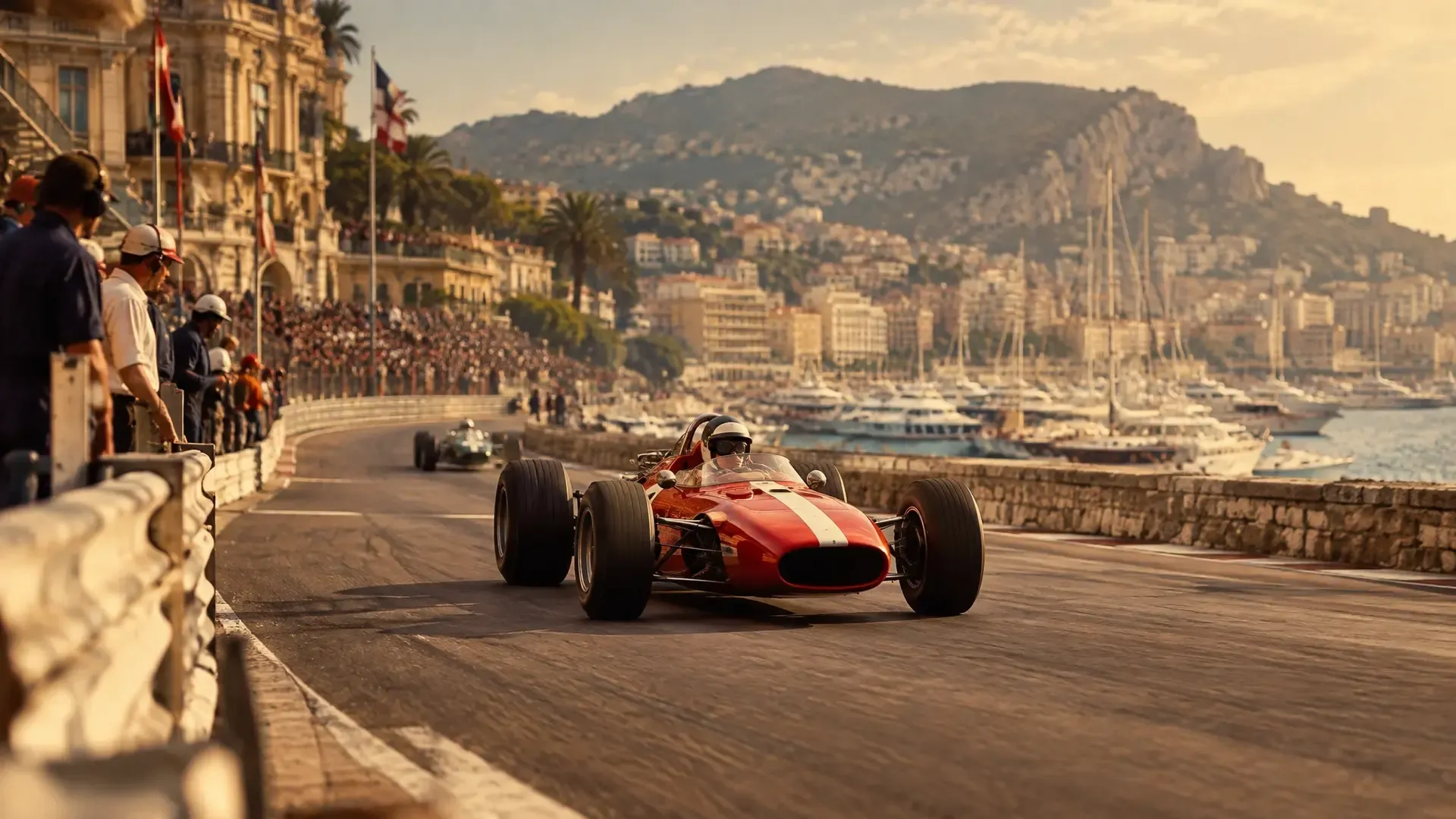
5. 1961 Monaco Grand Prix — Monte Carlo
Monaco has always rewarded precision, concentration and mechanical sympathy, and the 1961 race placed those demands under a harsh spotlight. Stirling Moss, driving a privately entered Lotus against the faster Ferrari opposition, produced one of the great defensive performances in Grand Prix history.
Moss kept the Ferraris of Richie Ginther and Phil Hill behind him around the narrow Monte Carlo circuit, where overtaking was exceptionally difficult but any error could end a driver’s afternoon. His victory was not based on superior machinery. It came from placing the Lotus exactly where it needed to be, carrying speed through the corners and maintaining relentless concentration for the full distance. That is why this remains one of the defining historic Formula 1 circuits stories: the circuit itself was an active part of the contest. Monaco converted every metre of track into a tactical problem, and Moss solved it better than the faster cars behind him.
4. 2005 Japanese Grand Prix — Suzuka
The 2005 Japanese Grand Prix was a race of recovery drives, changing fortunes and one perfectly timed final-lap pass. Because qualifying had been disrupted by weather, the grid placed several leading drivers out of their usual positions. Kimi Räikkönen started seventeenth, while Michael Schumacher and Fernando Alonso also faced difficult afternoons from the midfield.
Räikkönen cut through the field and eventually found himself chasing Giancarlo Fisichella for victory. The Renault driver had defended strongly, but Räikkönen stayed close enough to attack. On the final lap, he passed Fisichella at the first corner and took one of the most memorable wins of his career. Alonso also produced a spectacular drive to finish third after passing Schumacher around the outside of the 130R corner. Suzuka’s flowing layout encouraged commitment, but the race’s deeper appeal came from the way it gave several drivers room to create their own stories. It was both a tactical race and a showcase for speed under pressure.
3. 1971 Italian Grand Prix — Monza
Monza’s long straights and slipstreaming battles created one of the closest finishes in Formula 1 history in 1971. Peter Gethin won the Italian Grand Prix by only 0.01 seconds, with the leading group separated by tiny margins at the finish.
The race was less about one dominant driver than about momentum, positioning and the aerodynamic tow created along Monza’s straights. Cars could gain ground rapidly, only to surrender it again before the next braking zone. Gethin emerged from the final exchange ahead of Ronnie Peterson, François Cevert, Mike Hailwood and Howden Ganley. The result made the circuit’s character impossible to ignore: Monza’s open layout rewarded bravery under braking but also punished any driver who misjudged the timing of a slipstream. It remains a classic because the winner was unknown until the last metres, and because the finishing order reflected the circuit’s unique racing culture rather than a simple difference in pace.
2. 1991 Brazilian Grand Prix — Interlagos
Ayrton Senna had won in Brazil before, but the 1991 victory at Interlagos carried a special emotional weight. He led at his home circuit while his McLaren developed a gearbox problem that left him stuck in sixth gear during the closing stages.
Senna’s advantage over Nigel Mansell had been substantial, but the mechanical failure turned the final laps into a physical test. Every corner required unusual effort, and the Brazilian driver crossed the line exhausted after holding on to victory. Mansell’s Williams had been the faster car for much of the afternoon, making Senna’s control of the deteriorating McLaren even more impressive. The race is remembered not simply because a home favourite won, but because the victory revealed the cost of doing so. The crowd, the circuit and the driver’s physical struggle combined to create one of the most human victories in F1 history.
1. 2008 Brazilian Grand Prix — Interlagos
The 2008 Brazilian Grand Prix earns the top place because it combined a high-quality race with a championship ending that remained uncertain until the final corner. Felipe Massa won from pole and appeared to have done everything necessary for Ferrari, while Lewis Hamilton needed to finish in the required position to claim his first world championship.
Rain made the closing stages especially difficult. Hamilton lost places after making a cautious tyre choice, then recovered as the track changed again. Massa crossed the finish line believing he had won the title, but on the final lap Hamilton passed Timo Glock, whose dry-weather tyres were struggling in the rain, and took fifth place. That was enough for Hamilton to win the championship by a single point. The drama was not built on one spectacular overtaking duel; it came from the interaction of weather, tyre decisions, changing pace and championship pressure. Interlagos became the stage for a finish that was both a thrilling race result and a defining piece of modern sporting memory.
Why these races endure
The common thread is not simply excitement. These races endure because uncertainty exposed character. Moss had to outthink faster Ferraris at Monaco; Senna had to manage a damaged gearbox; Räikkönen had to turn a poor grid position into a win; Hamilton’s championship depended on surviving a rapidly changing final lap.
They also show the difference between types of greatness. Some races are thrilling because the lead changes repeatedly. Some become historically important because they settle a title or reveal a change in the sport. Others become culturally iconic because fans attach them to a place, a rivalry or a driver’s defining moment. The strongest Grand Prix combine all three qualities, although they do not need to do so in equal measure.
That is why these events remain central to discussions about Formula 1 legends and Formula 1 rivalries. Their results can be recorded in a few lines, but the races themselves resist such compression. They survive in the memory because competition, context, risk and human performance came together at exactly the right—or most dangerous—moment.