
The evolution of Formula 1 tyres: from treaded rubber to modern compounds
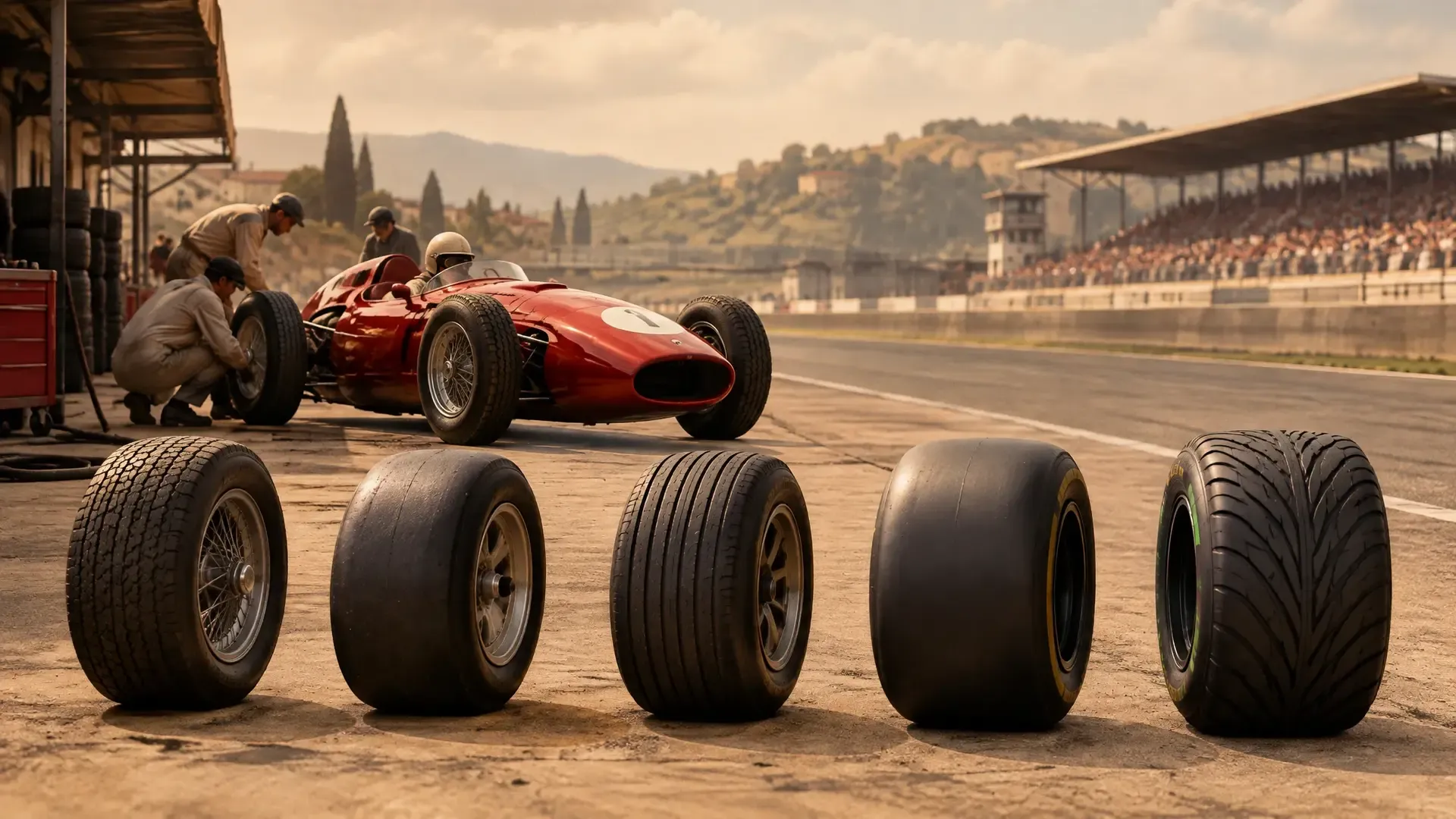
The evolution of Formula 1 tyres: from treaded rubber to modern compounds
Formula 1 tyres are among the most influential parts of a racing car, even though they are often treated as a detail beside the engine, wings or suspension. They are the only components connecting the car to the track. Their shape, construction and rubber determine how much braking and cornering force a driver can use, how quickly a car reaches its working temperature and how long that performance lasts.
The story of F1 tyres is therefore also a story of regulation and competition. Treaded tyres suited the technology and track conditions of the early championship. Slicks later maximised dry-weather grip, grooved tyres were introduced to limit performance, and rival suppliers turned tyre choice into a major technical contest. Modern Formula 1 has returned to slicks, but the engineering challenge is more sophisticated than ever.
From treaded tyres to the search for dry grip
Early Grand Prix tyres used visible tread patterns rather than the smooth surfaces associated with modern dry-weather racing. Treads were useful when a tyre had to deal with water, dirt and imperfect surfaces. Channels could help move water away from the contact patch, while the design reflected the materials, circuits and expectations of the period.
A treaded tyre does not place one uninterrupted area of rubber on the asphalt. The grooves divide the contact patch and reduce the amount of rubber pressing directly against a dry track. That is not necessarily a disadvantage in wet conditions, where dispersing water is essential, but on a dry circuit the ideal is usually different: as much stable rubber-to-road contact as possible.
That principle led to the development and adoption of slick tyres. A slick has no water-clearing grooves across its main contact surface, so it can offer a larger continuous footprint in dry conditions. More contact can mean greater braking and cornering grip, provided the tyre is at the correct temperature and the track is dry. Slicks did not make every problem disappear. Their performance still depends on carcass stiffness, rubber formulation, load and temperature, and they become a poor choice when water begins to form a film between rubber and asphalt.
The rise of slicks belongs to the wider technical development traced through formula 1 history, when teams increasingly looked for gains in every part of the car. By the 1970s, slicks had become central to dry-weather Grand Prix racing. They allowed the suspension and aerodynamics to work with a tyre designed specifically to generate maximum grip on a clean, dry surface.
The slick era and why grooves returned
For much of the 1970s, 1980s and early 1990s, slick tyres were a defining feature of Formula 1. As chassis, aerodynamics and engine performance advanced, tyre technology became part of an escalating pursuit of speed. Better rubber and stronger constructions helped cars carry more speed through corners, while teams worked closely with suppliers to match tyres to their suspension systems and aerodynamic loads.
Regulators eventually sought to reduce dry-weather performance by requiring grooves in the tyres. Grooved tyres were introduced for the 1998 season, beginning a distinct era in F1 design. The grooves interrupted the smooth contact surface and reduced the dry grip available from the tyre. The intention was not to make the cars slow in every respect, but to limit cornering performance and alter the balance between mechanical grip and aerodynamic grip.
Grooved tyres were not the same as the treaded tyres used for wet weather. Their grooves were a regulatory device for dry racing, while wet-weather patterns are designed primarily to move water. A grooved dry tyre could still be used on a dry track, but it generally offered less peak contact and a narrower performance advantage than an equivalent slick. Teams had to adapt suspension settings, ride height, camber and strategy to a tyre that behaved differently from the slicks it replaced.
The period also demonstrated that a regulation change rarely produces a single, simple result. Engineers learned to recover some lost grip through construction, compound development and aerodynamic efficiency. The grooved era therefore became a technical contest in its own right rather than merely a slower version of the slick era.
Tyre wars: when suppliers shaped the competition
Tyres became especially prominent during the supplier battles of the 1990s and early 2000s. Goodyear and Bridgestone competed in Formula 1 during the late 1990s, and Michelin joined Bridgestone as a major rival from 2001 until 2006. These were not simply branding contests. Suppliers developed different constructions and compounds, and teams had to choose the car and setup that best suited a particular tyre philosophy.
Competition between suppliers could influence qualifying performance, race durability and the timing of pit stops. A softer compound might produce more grip over a short qualifying run, but could lose performance more quickly over a race stint. A harder option might be less spectacular at first yet remain consistent for longer. Construction also mattered: a tyre that responded well to heavy aerodynamic loads could favour one car, circuit or driving style over another.
This made tyre selection part of the competitive identity of a team. A successful combination of chassis, suspension and tyre could produce a major advantage, while a supplier’s improvement could change the balance of power without any obvious alteration to the engine. The subject sits naturally alongside the stories of formula 1 legends, because drivers had to understand how to extract performance from tyres that could behave very differently across a lap.
There were also sporting and political consequences. If a supplier produced a tyre that was exceptionally strong in qualifying, its teams could gain track position even if another supplier was better over a long stint. Conversely, durability could reduce the need for pit stops and reward a different style of race planning. The tyre wars made the supplier relationship a strategic asset, but they also made it harder to compare teams on chassis performance alone.
Formula 1 returned to slick dry tyres for the 2009 season, following the grooved-tyre period. The change restored the smooth contact surface but took place alongside wider technical changes, so teams still had to relearn how to generate and preserve mechanical grip. Bridgestone became the sole tyre supplier from 2007 through 2010, ending the direct supplier competition before Pirelli took over the role in 2011.
Pirelli and the modern tyre system
Since 2011, Pirelli has supplied Formula 1 with a range of dry-weather compounds as well as intermediate and full wet tyres. The modern system is not built around one universally best tyre. Instead, the supplier brings compounds with different levels of hardness and operating behaviour, while the regulations define how teams may use their available sets during a race weekend.
A dry slick compound is selected according to the expected demands of the circuit and the event’s tyre allocation. Softer rubber usually offers stronger peak grip and can warm up more readily, but it may be more vulnerable to overheating or wear. Harder rubber generally sacrifices some immediate performance for greater resistance to degradation and a longer useful stint. The actual result depends on the track surface, weather, car setup and how smoothly a driver manages the tyres.
It is important to separate compound from construction. The compound is the rubber formulation that influences grip, temperature range and wear. Construction describes the tyre’s internal architecture and carcass behaviour: how it supports loads, deforms under cornering and responds to changes in pressure and temperature. Two tyres can have different constructions even when their compounds appear similar, and a change in construction can alter how a car uses its suspension and aerodynamic load.
Modern F1 also uses 18-inch wheels, introduced in 2022, replacing the previous 13-inch format. The larger-wheel package changed the proportions of the tyre and contributed to a different balance between sidewall movement, steering response and temperature management. It was another example of a technical change that affected not only peak grip but also the way drivers and engineers controlled tyre behaviour through a lap.
Intermediates, full wets and the limits of slicks
Wet-weather tyres are not interchangeable. Intermediates are designed for a damp or drying track: conditions in which there is enough moisture to make slicks unreliable, but not necessarily enough standing water to require the deepest water-clearing pattern. They can be effective when the surface is changing quickly and the driver needs a compromise between wet-weather security and dry-track speed.
Full wet tyres are intended for substantially wetter conditions, including significant surface water. Their more pronounced tread is designed to displace water and reduce the risk of aquaplaning. They are not simply a slower version of an intermediate. On a merely damp track they can overheat or lose performance, while on a very wet surface an intermediate may struggle to clear enough water from the contact patch.
Weather therefore turns tyre choice into a moving decision. A team may start on an intermediate, then switch to slicks as the racing line dries. If rain intensifies, the direction can be reversed. Circuit characteristics matter too: a fast, exposed track and a slow circuit with drainage limitations can place very different demands on the same tyre. That is why the history of historic formula 1 circuits is also relevant to understanding tyre development; surface, layout and climate all shape the problem suppliers must solve.
How modern tyres shape strategy
Today’s tyre story ends not with one decisive design, but with a managed system of compromises. Teams select from available dry compounds, work to bring them into their operating window and monitor thermal degradation throughout a stint. A tyre that is too cold may lack grip, while one that is overheated can slide and wear more quickly. Degradation is not simply the number of laps completed; it is the loss of performance caused by wear, overheating or an unsuitable balance between the car and the surface.
Mandatory allocations and sporting rules also influence strategy. Teams cannot bring an unlimited number of fresh sets, and the available choices must be planned across practice, qualifying and the race. The best strategy may involve a faster soft tyre, a durable hard tyre, or a carefully timed change between slicks and wet-weather rubber. In every case, the historical lesson remains clear: tyre design changes racing because it changes the amount of grip available, the way that grip disappears and the decisions teams must make to preserve it.
From early treaded rubber to slicks, grooved tyres, supplier battles and modern compound families, Formula 1 tyres have evolved in response to engineering ambition and sporting control. They remain a compromise between speed, stability, temperature and durability—and one of the clearest ways to see technology and regulation shaping the race itself.