
The Dutch Grand Prix at Zandvoort: A History from 1952 to Its 2021 Return
The Dutch Grand Prix at Zandvoort: A History from 1952 to Its 2021 Return
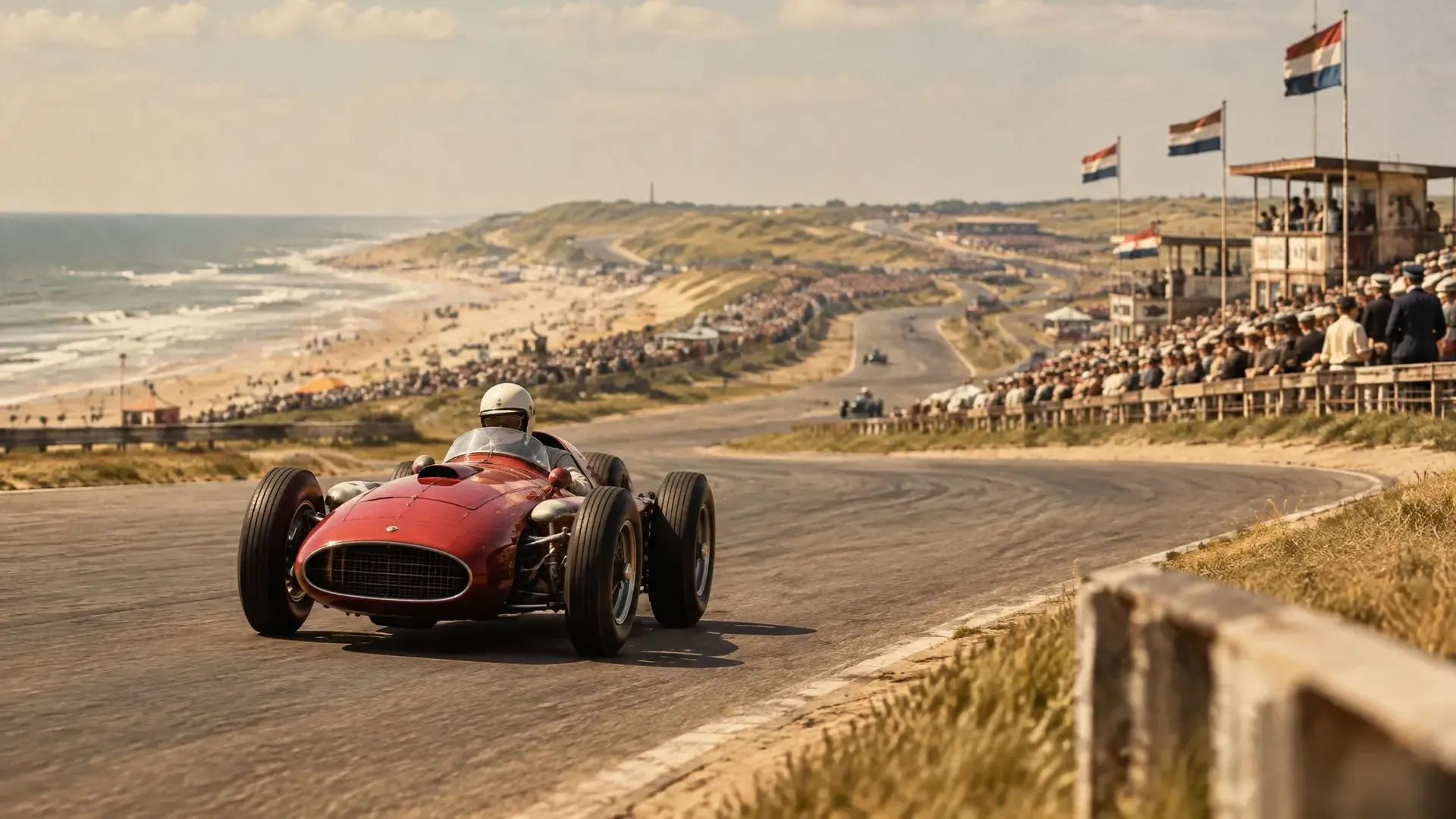
The Dutch Grand Prix has always been closely tied to Zandvoort, a circuit set among the dunes on the Netherlands’ North Sea coast. Its fast, flowing character made it one of Formula 1’s distinctive historic venues, while its long absence from the calendar showed how difficult it could be to preserve an old circuit in a changing sport. When Formula 1 returned in 2021, it was not simply a new event in the Netherlands. It was the revival of a race with roots stretching back to the championship’s formative years.
Before the championship: Zandvoort’s early races
Zandvoort was developed as a racing venue after the Second World War, using roads in and around the coastal resort. The circuit quickly became a natural home for major international motor racing in the Netherlands. Its setting was unusual for a Grand Prix venue: the track ran through dunes rather than an urban landscape or a purpose-built industrial complex. The combination of elevation changes, long corners and high-speed sections gave the circuit a character that was immediately recognisable.
The Dutch Grand Prix held on 17 August 1952 was part of that early period, but it was not a round of the official World Championship. It was instead a non-championship Formula 1 event, run during a season in which championship races used Formula 2 regulations. That distinction matters because the race is often treated as an early chapter in Dutch Grand Prix history, but Zandvoort’s official championship debut came later. The 1952 event nevertheless demonstrated the circuit’s importance and its readiness to host the leading drivers and teams of the era.
For readers exploring the wider development of the sport, this early period fits into the broader Formula 1 history of a championship that was still establishing its calendar, regulations and international identity. Zandvoort was already a serious European venue before it became a regular World Championship stop.
Zandvoort joins the Formula 1 calendar
The Dutch Grand Prix became a World Championship round in 1958. By then, Zandvoort had earned a place alongside other important European circuits. The race was won by Stirling Moss, whose victory underlined the track’s suitability for drivers able to combine precision with commitment. The circuit’s quick corners rewarded rhythm and confidence, but its sandy surroundings also made grip unpredictable when wind moved sand onto the racing line.
Through the late 1950s and 1960s, the Dutch Grand Prix became a familiar part of the Formula 1 season. Zandvoort’s long, sweeping layout produced a very different challenge from slower street circuits and tighter permanent tracks. Cars were asked to carry speed through open corners, and drivers had to manage the changing balance of their machines over a lap that felt exposed and fast. The seaside atmosphere was part of the event’s identity, but the circuit was valued primarily because it tested a driver’s technique and a car’s high-speed stability.
The venue also belonged to a generation of circuits where the boundaries between spectacle and danger were becoming increasingly difficult to accept. Its character made it memorable, yet the same speed that created its appeal raised serious questions as Formula 1’s safety expectations developed.
Safety pressures reshape the circuit
During the 1970s, Formula 1 changed rapidly. Cars became faster, protective equipment improved and drivers increasingly demanded proper barriers, escape roads, medical provision and fire response. Older circuits were expected to modernise rather than rely on tradition. Zandvoort responded with alterations and additional safety infrastructure, including changes intended to slow cars and improve protection around the track.
The transition was not straightforward. The 1973 Dutch Grand Prix was overshadowed by the death of Roger Williamson after a crash and fire. The tragedy exposed the consequences of inadequate rescue procedures as well as the dangers of the circuit environment. It became part of the wider safety debate that was transforming Formula 1, and it demonstrated that adding equipment or changing a corner could not by itself solve every problem.
Zandvoort continued to host championship races, but its layout was no longer treated as untouchable. Chicanes and other modifications altered the rhythm of the lap, while improvements to barriers, access and emergency facilities reflected the sport’s new standards. These changes helped the event continue, but they also showed the tension between preserving the character of a historic circuit and making it acceptable for modern racing.
The 1970s and early 1980s are therefore best understood as a period of adaptation rather than simple decline. Zandvoort remained one of the sport’s memorable venues, and races there continued to feature leading drivers and teams. At the same time, financial and organisational pressures were becoming more important as Formula 1 grew more commercial and the calendar became increasingly competitive. The history of historic Formula 1 circuits often follows this same pattern: a celebrated layout must evolve or risk losing its place.
The final pre-hiatus race in 1985
The Dutch Grand Prix’s final championship appearance before its long absence came in 1985. Niki Lauda won that race, finishing ahead of his McLaren team-mate Alain Prost after a close contest. It was Lauda’s last Formula 1 victory, giving the final pre-hiatus event an additional place in the sport’s history.
After 1985, the Dutch Grand Prix disappeared from the World Championship calendar. The reasons were not a single, universally simple decision. The event faced a combination of financial difficulties, organisational challenges, the cost of meeting modern safety requirements and competition for limited places on the Formula 1 schedule. It is more accurate to describe the absence as the result of several pressures than to assign it to one isolated cause.
Zandvoort itself did not vanish from motorsport. The venue continued to host racing and remained part of the Netherlands’ circuit infrastructure, even as the Formula 1 event was absent. That continuity mattered. It preserved the circuit’s identity and experience while the possibility of a return depended on whether the venue could be modernised and whether a viable Formula 1 project could be assembled.
Why Zandvoort was a natural candidate for a comeback
By the time Formula 1 began seriously revisiting the Netherlands, Zandvoort offered something that a newly built circuit could not easily reproduce: a deep connection with the championship’s past. Its coastal setting, quick corners and place in the memories of earlier generations gave the proposed race an immediate historical context. The revival was also helped by renewed Dutch interest in Formula 1, although the comeback should not be reduced solely to one driver or one fan movement.
A return required more than restoring an old name to the calendar. The circuit had to meet contemporary safety and operational expectations while retaining enough of its original personality to remain recognisably Zandvoort. That meant work on the track surface, run-off areas, barriers and other facilities, as well as changes to selected corners.
The 2021 return to the Netherlands
Formula 1’s return to Zandvoort was announced in 2019 for the 2020 season. The first planned running was postponed during the disruption caused by the COVID-19 pandemic, so the Dutch Grand Prix finally returned on the 2021 calendar. This made the event’s comeback especially notable: the Netherlands had waited more than three decades for a championship race, and the modern revival had itself been delayed before a car completed a competitive lap.
The renovated circuit was not presented as a museum piece. Safety upgrades and venue improvements were combined with visible changes to the track. The banking at the Hugenholtzbocht was increased, and the final corner, Arie Luyendijkbocht, was also given a much steeper profile. Those changes were intended to create a more modern racing challenge and to help cars carry speed through the corners, while new run-off and protective measures brought the venue closer to current Formula 1 requirements.
The redesigned sections changed how drivers approached a lap. Instead of treating every corner as a flat, conventional turn, they had to manage banking, speed and positioning in ways that were unusual on the contemporary calendar. The result was a circuit that looked familiar in photographs but behaved differently from the Zandvoort of the 1970s and 1980s. Its narrow, flowing nature also meant that qualifying position and race strategy remained important when overtaking was difficult.
The 2021 event therefore connected two versions of the venue. The old Zandvoort was a fast seaside track associated with classic cars, exposed corners and a more hazardous era of Formula 1. The new Zandvoort kept the dunes, the atmosphere and much of the flowing spirit, but added the safety systems, facilities and engineering changes expected of a modern World Championship circuit. That balance was central to the comeback.
Why the 2021 comeback matters
The return of the Dutch Grand Prix was historically important because it restored a missing link in Formula 1’s European story. Zandvoort had hosted the championship during its growth, disappeared when the demands of the sport became harder to meet, and returned only after a substantial modernisation effort. Its history is not simply a list of races: it is a record of how Grand Prix venues have had to respond to speed, safety, finance and changing expectations.
For that reason, Zandvoort belongs among the sport’s defining venues and alongside the drivers remembered as Formula 1 legends. The 2021 race did not recreate the past exactly, nor was it intended to. It showed that a historic circuit could preserve its identity while changing enough to earn a place in the modern championship.